V Pie R 2h Solve For H
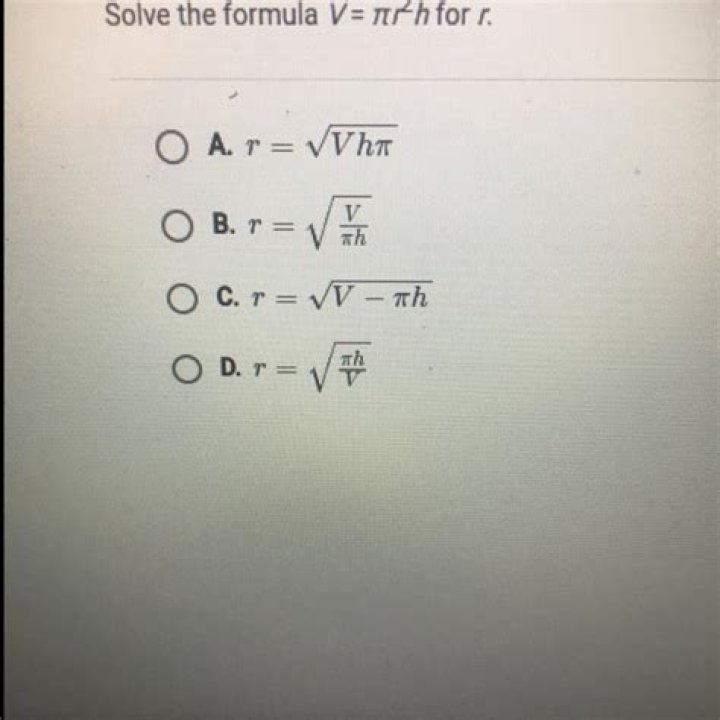
V Pie R 2h Solve For H
Dissolve after h. V = Â € r 2j? 3
Dissolve after h. V = € € r 2j
A.h = V / £ Â… Âr 2
B.h = V £ Â… Âr 2
Vs. h = Vr 2 / £ Â…
D. h = VÃ £… Â / r 2
Choose the equation that best represents: the largest of the two consecutive odd numbers is less than 7 times twice.
A.x = 2 (x + 1) 7
B.x + 1 = 7 2x
c.x + 2 = 2x 7
D.x = 2 (x + 2) 7
V = € € r 2j
Divide both sides by € r 2.
V / Â € r 2 = € r 2h / Â € r 2 ==> (Â € r 2 canceled on the right, leaving only h)
V / Â € r 2 = h ==> a.
um and x are the first odd numbers, so (x + 2) will be the next odd number.
The largest of the two consecutive odd numbers (ie x + 2) is less than 7 times less (7 2x).
x + 2 = 2x 7 ==> c.
If V = pi * r 2 * h
Then h =?
Divide h and V by pi * r 2 to get h in your o. Get
v / (pi * r 2) = h
Let x = the smallest number
x + 2 = Enter a larger number.
The largest number of two consecutive odd numbers (x + 2) is (=) 7 minus (7) by twice the smallest number (2 * x)
x + 2 = 2x7
The formula for the number of cylinders. Get a liter of water quickly with the weather. This is a cylinder. Complete round (empty). The diameter is the area around your back (or around the ideal drinking area). Its radius is one million / 2. gl tip is h. Once you take the area from the back and multiply it, you get Quany. The part is two-dimensional, the quany is three-dimensional (hence, for example, the intention may be cubic inch instead of square inch). ?????????????????????? h = V / (pi * r 2).
V = pi * r 2 * h
Divide both sides by pi * r 2.
v / (pi * r 2) = h
A is the answer.
x + 2 = 2x7
This is the answer