Revenue Operations: Unifying Marketing, Sales And Service Operations
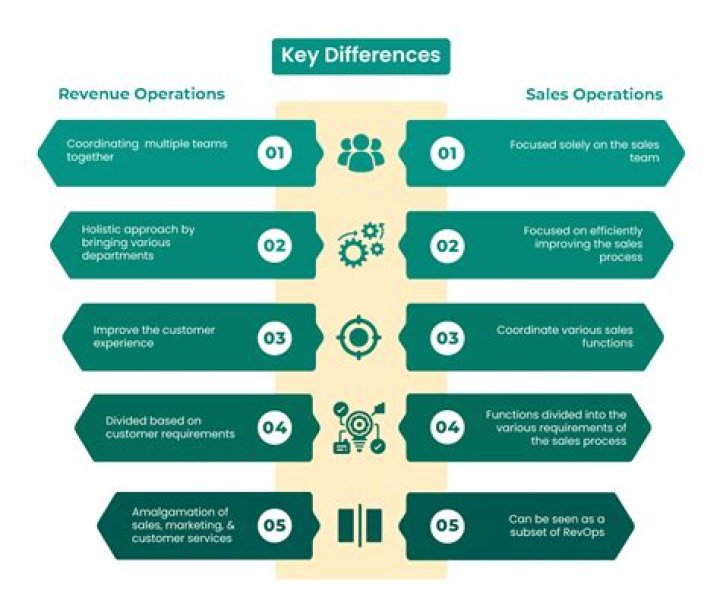
As businesses strive to scale sustainably, the demand for RevOps (Revenue Operations) solutions is growing everywhere. But when executives look at these operational solutions, there can be confusion about what it really takes to drive growth.
RevOps is described as everything from a philosophy to a lifestyle to an easy way to align your tech stack. The reality is that it is somewhere in between. It's more than just managing your software stack, but it's not a giant abstract ideology either.
See RevOps as a way to increase efficiency and get the most out of your people and technology,” said Director of Services Al Moore. Your technology must be designed to serve your people. RevOps isn't just about quickly aligning marketing and sales, it's about empowering employees and optimizing the total investment you make in your business.
It starts with building a solid operational foundation based on overall revenue goals and the right sales and marketing processes to achieve them. And it continues with continuous integration, data analytics and process improvements that help you get the most out of your people and better understand your customers,” continues Al.
Evolution of the RevOps mentality
One of the main reasons why RevOps is often misunderstood for being just a technology is that people think of its components as marketing activities, sales activities, and service activities.
Until now, these three operational areas existed separately, often scattered. However, in recent years there has been a shift and organizations have come to understand how cross-functional alignment of processes and technology can lead to better business operations.
“If you're really serious about RevOps, look at it through a data integrity lens and use it to better support your people and your business as a whole,” says Al. You have to look at it through all these workflows: marketing operations, service operations, sales operations, and consider it an ongoing investment, as all three fit into your overall business.
When you add them up, you visualize your entire company in such a way that the sum is greater than the individual pieces. RevOps doesn't just remove barriers between departments, it connects everything seamlessly, leading to a consistent buyer and customer journey.
The goal of a RevOps project should not just be to integrate platforms or create a reporting platform, but to complement these tactics to improve the overall functioning of the organization.
According to Al, this should be part of an overall cultural shift where you look at your data from a holistic perspective and move from reporting data to analyzing real data. Reporting should be just the beginning, as you also want to build confidence within your organization in what you can do with these reports and continually invest in iterating and improving your overall data workflow.
Real operational improvements come when you move from tackling an acute pain point to a full lifecycle solution. How will these operational efforts improve lead routing, funnel development, and/or customer success?
Most importantly, you don't see it as if I need technicians to deduplicate my CRM, set up integrations and perform migrations,” says Al. You need to ask more of the right questions and invest in your internal team in a way that empowers them to do so. What happens after the migration? What happens after the data sets are deduplicated? What happens after implementation? How can we develop systems and processes that allow us to act on this data and accelerate revenue growth?
Appetizer
As operational technologies continue to improve, revenue-generating activities are quickly becoming a critical factor in an effective growth strategy with the potential to unify, align and scale new and existing revenue streams.
The success of RevOps at scale depends on a massive investment in the alignment of processes and technology across the enterprise and a commitment to data integrity to deliver a consistent customer experience.
If you view RevOps as a project or set of results that focus on a specific area, such as B. acquisition or new business reporting, your potential for long-term success will be severely limited.
Success begins with basic system setup and data cleansing, but must extend to an ongoing process of analytics, automation, technology integration, and process tuning throughout the customer lifecycle.
Literal Meanings of Revenue Operations: Unifying Marketing, Sales And Service Operations
Revenue:
Meanings of Revenue:
Investment income.
The total income from this source.
All income from taxes and other funds for specific political entities of the Treasury.
Total sales.
Net income from ordinary activities.
Refund slightly refunded.
Generate income.
Generate income.
Operations:
Meanings of Operations:
The method by which a device performs its function.
The method or practice by which actions are performed.
The act or process of exercising power, whether physical, mechanical, or moral.
Planned affairs.
Company or organization.
Surgical procedure.
A method to generate a value from one or more values (operands).
Military campaign (e.g. Operation Desert Storm).
Product effect effect.
Sentences of Operations
The rescue operation "Katrina" was considered a failure.
He runs a multinational that supplies raw materials.
He underwent surgery to remove his appendix.
Unifying:
Meanings of Unifying:
Merge, consolidate, merge and combine.
Become one.
Union.
The tendency to unite. Promote unity. Unite unity.
Marketing:
Meanings of Marketing:
Bargain in the market to buy or sell food or goods to get a good deal.
Sentences of Marketing
We hope to launch an eco-friendly model in the next quarter.
Sales:
Meanings of Sales:
(abbreviation for Discount Sale) Sale of goods at discounted prices.
Auction act to the highest bidder.
Sentences of Sales
You have an offer: 50% discount.
Turnover grew by 12% compared to the previous year.
And:
Meanings of And:
In the rhythm, the second half is divided by beat.
Breathe in the whispering design, imagine.
Service:
Meanings of Service:
A service provided by a company, organization, authority, etc.