Quickening pregnancy - How To Discuss
Quickening pregnancy
What does quickening feel like in pregnancy? Acceleration is defined as the first time you feel your child move. This is a highly anticipated event in any pregnancy. If you are pregnant with your first child, you can expect to feel your baby for the first time between 18 and 24 weeks of pregnancy. If this isn't your first child, chances are you'll be placing your child a little earlier than the first time.
How early would you feel quickening during the 2nd pregnancy?
If this is your first pregnancy, you may not be able to feel your baby's movements for 25 weeks. From the second pregnancy, some women feel that they are moving from 13 weeks. Your baby is more likely to move if you are in a calm position, whether you are sitting or lying down.
What is quickening when does it occur?
Acceleration is a term used to describe the floating sensation an expectant mother experiences when she first feels the movement of her baby. This often happens between weeks 17 and 20 of pregnancy, but since every pregnancy is unique, it can happen a little earlier or later.
What does quickening feel like and when does it start?
Some mothers begin to feel their babies move as early as 13 to 16 weeks after the start of their last period. These first fetal movements are called acceleration and are often described as pulsations. It can be hard to tell if this feeling is related to gas or your baby's movements, but you'll soon notice a trend.
How often should your baby be moving at 26 weeks?
For example, the American Congress of Obstetricians and Gynecologists (ACOG) recommends measuring the time it takes to feel 10 fetal movements. ACOG recommends doing this at about the same time each day (when your baby is most active), starting at week 28 (or week 26 if you have a high-risk pregnancy).
When you should worry about decreased fetal movement?
When Should You Be Concerned About Reducing Fetal Movement? If your child has not felt any movement for 24 weeks, see your doctor or midwife. If you think your child has reduced strength or range of motion, see your midwife or doctor immediately. Don't wait until the next day.
 When will my partner feel the baby kick?
You will probably feel that your baby only moves between the ages of 16 and 22 weeks. It usually takes a little longer for your baby to feel the activity outside your tummy. In addition, every pregnancy is unique, so your partner can give birth to a child up to 20 years old.
 What does quickening feel like during pregnancy mean
Acceleration is the feeling of your growing baby writhing in your womb for the first time. The feeling usually starts with a slight shudder. Pregnant women often describe this as butterflies (like lovers!) or gas as another common pregnancy symptom.
What does quickening feel like during pregnancy in women
Acceleration often resembles spasms, palpitations, or blisters. Rose says many early mothers mistake fetal movement for gas. As the pregnancy progresses, the movements become more pronounced and in the third trimester they can resemble painless thrusts with the legs or fists.
What does quickening feel like during pregnancy in dogs
Acceleration often resembles a contraction, a beat, or a hit. Rose says many early mothers mistake fetal movement for gas. As the pregnancy progresses, the movements become more pronounced and in the third trimester they can resemble painless thrusts with legs or arms. Also, the acceleration can be more noticeable at certain times of the day.
 How early can you feel flutters in pregnancy?
First fetal movement: acceleration Some mothers can feel their baby moving as early as 13-16 weeks after the start of their last period. These first fetal movements are called acceleration and are often described as pulsations. It can be difficult to tell if this feeling is related to gas or your baby's movements, but you'll soon notice a trend.
 How often should you feel fetal movements during quickening?
“After accelerating for the first few launches, you may not feel the fetal movement every day,” Rose says. “There is a lot of amniotic fluid and a small, light baby that moves. However, by the time you are 2426 weeks pregnant, your baby will have less room to move and you will likely feel movement every day.
What does quickening feel like during pregnancy look
Acceleration can make butterflies resemble a flutter in the stomach or even a thud in the stomach. If you've ever been pregnant, you may be familiar with the sensation of floating, and you may know that it speeds up a little earlier, perhaps closer to 16 weeks of pregnancy.
What is pregnancy Quickening and how do I Feel It?
The first time you feel your baby move and start to notice it is called an accelerated pregnancy. Many mothers experience this as a ■■■■ from the inside or trembling as if a bird is flying.
 How early can you feel quickening?
If the conditions are right you can already feel acceleration or first movements after 12 weeks, for example: 1 if you have ever been pregnant 2 if your placenta is at the back of the uterus 3 if you have an active baby.
 When will I Feel my Baby Move during pregnancy?
You will feel the baby's movements for the first time around the fifth month of pregnancy; this is called acceleration. In pregnant women, the acceleration may occur a little earlier, perhaps after 16 weeks. Be patient if you haven't felt anything yet.
 When do you start feeling Quickening in pregnancy?
You are more likely to have an accelerated pregnancy when you reach the second trimester.
What happens in the second trimester of pregnancy?
By the end of the second trimester, you may feel that your baby has become much more active. It's no longer the feeling of floating when accelerating, but you feel every hit, hit, hit and even hiccups much more.
 How early would you feel quickening during the 2nd pregnancy test
You should feel your baby's first movement, known as adhesions, between 16 and 25 weeks of pregnancy. If this is your first pregnancy, you will not be able to feel your baby's movements for 25 weeks. From the second pregnancy, some women feel that they are moving from 13 weeks.
 Can you feel baby kicks in the second trimester?
The second and third mothers are better able to distinguish the infant's first movements from gas, hunger pangs, and other internal movements. In the second and third trimesters, the movement should be more noticeable and you should be able to feel your baby's kicks, kicks and elbows.
What does quickening feel like and when does it start to come
By the end of the second or beginning of the third trimester, you will likely notice an increase in fetal movements (pounding, thumping, etc.) The acceleration is felt much earlier, between 17 and 20 weeks.
 When does the baby start kicking during pregnancy?
From the second pregnancy, some women feel that they are moving from 13 weeks. Your baby is more likely to move if you are in a calm position, whether you are sitting or lying down. What does a walking baby look like? Pregnant women describe their baby's movements as butterflies, twitches or wiggles.
 What are the early signs of a second pregnancy?
Another early sign of your second pregnancy, like your first, is morning sickness. Hormonal changes in the body usually cause this nausea after the first month. In most women, nausea and vomiting go away after 16 to 20 weeks.
 How early can you feel baby move in second pregnancy?
However, with more experience, mothers can feel the movements a second time faster, as they have learned to distinguish between the baby's real movements and. gas! Some women start exercising at 13 weeks into their second pregnancy.
How early can you feel flutters in second trimester?
FLUTTER (speeds up) This isn't all bad news for the second quarter! Depending on your body type and the location of the placenta, you can feel your baby in week 2021. If this isn't your first pregnancy, you'll probably feel it sooner.
 How early would you feel quickening during the 2nd pregnancy time
You should feel your baby's first movement, called a rush, between 16 and 25 weeks of pregnancy. If this is your first pregnancy, you may not be able to feel your baby's movements for 25 weeks. From the second pregnancy, some women feel that they are moving from 13 weeks.
When does “quickening” happen during pregnancy?
Here's your guide to understanding "rush" during pregnancy. When does acceleration take place? "Pregnant women usually feel their first fetal movement after 17 weeks of pregnancy," said Georgia Rose, coordinator of obstetrics at Village Maternity in New York.
 When do you start to feel baby kick during pregnancy?
A: By the end of the second or beginning of the third trimester, you will likely begin to feel more intense fetal movements (pounding, thumping, etc.). The acceleration is felt much earlier, between 17 and 20 weeks.
When do you feel Quickening in pregnancy?
According to her, women notice an acceleration earlier in later pregnancies, around 16 weeks. Slim women also feel faster faster. You can also split up for several weeks, McCartney says.
How to know if you are pregnant for the second time?
7 things to know about a second pregnancy 1 They are more likely to show up in a second pregnancy. 2 Feel movement sooner. 3 You are more tired. 4 You are in more pain. 5 You experience more Braxton Hicks contractions during your second pregnancy.
When does quickening start during pregnancy?
Every pregnancy is unique and you may have to wait a while. For example, first-time mothers may accelerate their learning a little later, perhaps after about 18 weeks or even a few weeks.
 When does quickening occur in pregnancy?
Acceleration usually happens naturally in the middle of pregnancy. A woman who is pregnant for the first time (a primiparous woman) usually experiences fetal movement around 1820 weeks, while a woman who has been pregnant more than once (a multiparous woman) usually passes around 1517 weeks.
 What are the first signs of fetal movement during pregnancy?
When your baby is active, you can kick, punch or punch him, all common forms of fetal movement. Sometimes you even feel a rhythmic movement, which could be your little one's hiccups. The first small pulsating movements you feel are called acceleration and occur early in pregnancy.
What is quickening in abortion law?
acceleration. Throughout the history of Western law, it is clear that the deciding factor in punishing a woman for an abortion has often been whether there was acceleration. Acceleration was considered by most scientific standards to be the first reliable indicator of life in the womb.
 What is quickquickening and when does it happen?
Acceleration is a term used to describe the floating sensation an expectant mother experiences when she first feels the movement of her baby. This often happens between weeks 17 and 20 of pregnancy, but since every pregnancy is unique, it can happen a little earlier or later.
 How early can you feel baby kick in womb?
From the WebMD Quickening files. Feel the baby move in the womb, which is usually seen around 16 weeks of pregnancy. The movements can vary in intensity and range from a gentle push or gas ■■■■ in early pregnancy to quick movements or even painful jerks as the baby grows.
Is quickening normal at 17 weeks of pregnancy?
Not all women will have an increase around week 17 of pregnancy, and it doesn't necessarily mean health problems. “What a mother feels doesn't always correlate with what happens in the womb,” Rose says. She does recommend informing your gynecologist or midwife if you do not notice any acceleration after 18 to 20 weeks.
 What stage of pregnancy is also known as the quickening place
Between 16 and 18 weeks of pregnancy, a mother giving birth for the first time can feel the first floating movements of the fetus, known as acceleration, Birch said. "This is not the first pregnancy. The mother is more likely to feel the fetus kicking, twisting or turning because she knows what to expect," he said.
 What is the first fetal movement in pregnancy?
Babies start to move very early, so the term "first fetal movement" is misleading. The first movement of the fetus does not refer to the baby's first movement in the womb, but to how the mother first feels.
 What does quickening feel like?
Stomach pain has a name. The term "acceleration" refers to the first movements of the fetus that the mother feels. The sensation is often described as feeling like a butterfly beating, hunger pangs, cramps, bloating, or the need to go to the bathroom.
 What does quickening feel like and when does it start to fall
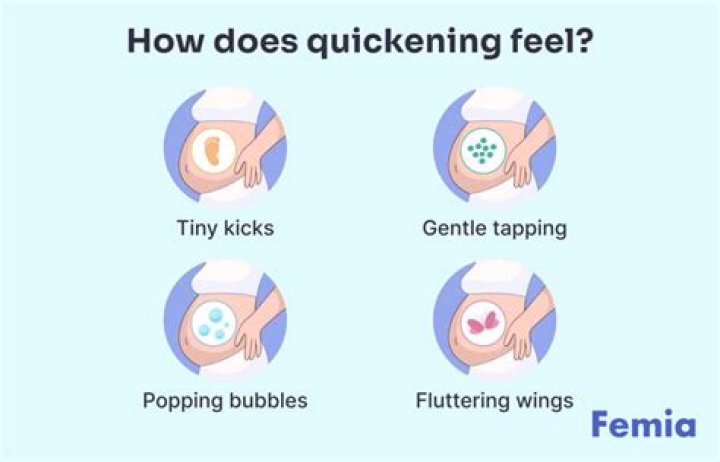
Accelerating usually feels like a light flutter of butterflies, a popcorn crunch, a soft growl in your belly, or even a fish swimming in your belly. In reality, every mother's experience is different. Initially, these flatteries are minimal, as the baby is still small.
What does quickening feel like and when does it start to end
Acceleration usually occurs between 16 and 20 weeks of pregnancy. These regular butterfly-like beats that you feel in your gut are a great reminder of the incredible changes your body goes through as your baby grows. It may seem like a stomachache or gas, but it's actually a baby on the way. Click here for a full answer.
What does quickening feel like and when does it start to stop
Accelerating usually feels like a light flutter of butterflies, a popcorn crunch, a soft growl in your belly, or even a fish swimming in your belly. In reality, every mother's experience is different. Initially, these flatteries are minimal, as the baby is still small. They can happen once a day, so it's easy to release them.
 When can you feel kicks from the outside?
Between 28 and 32 weeks of pregnancy, those around you can feel the baby move by placing their hands on your stomach at the right time and place. Even if you can feel the movement for several weeks, the baby needs to be a little bigger before you can feel it on the outside.
Quickening pregnancy definition
Some mothers may begin to feel their babies moving as early as 13 to 16 weeks after the start of their last period. These first fetal movements are called acceleration and are often described as pulsations. It can be hard to tell if this feeling is related to gas or your baby's movements, but you'll soon notice a trend.
What does pregnancy lightening feel like?
Lightning during pregnancy as an early sign of childbirth. Some women feel more pressure on their bladder, causing them to urinate more often, while others feel their baby is going to drop for the rest of their lives. These sensations are the result of the extra pressure that the baby's head puts on the rectum and pelvic floor.
What is the lightening feeling in pregnancy?
The throbbing pain is caused by the pressure and position of the baby as it moves through the birth canal to prepare for delivery. The good news is that the day of birth is approaching because of the burning pain. The bad news is that lightning can strike weeks before you leave for work.
 What month does lightening occur in pregnancy?
A pregnant woman can feel improvement after a few weeks, she sees her baby drop at 32 weeks. Some women have also tried to lighten or drop their baby shortly before delivery or a few hours before birth. The fact is that it takes into account the condition of the woman's body and how often the woman becomes pregnant.
 Quickening pregnancy meaning
The medical definition of acceleration. Acceleration: The moment of pregnancy when the baby first feels movement.
 Quickening pregnancy wikipedia
During pregnancy, acceleration refers to the initial movement of the fetus in the womb as seen or felt by the pregnant woman. According to the Oxford English Dictionary, acceleration means reaching the stage of pregnancy where the baby is showing signs of life.
 What is the earliest month for quickening to occur?
Around the fifth month of pregnancy you can feel the baby move, this is called acceleration. In pregnant women, the acceleration may occur a little earlier, perhaps after 16 weeks.
Quickening pregnancy sensation
Acceleration during pregnancy. One of the best sensations during pregnancy is when you first feel your baby. This is your child's first movement called acceleration. You usually feel this as you approach the middle of your pregnancy.
Why morning sickness during pregnancy may be a good sign?
Morning sickness is a feeling of nausea that can occur during the first trimester of pregnancy due to increased hormone levels in the body. Morning sickness may be accompanied by vomiting. Many doctors believe that morning sickness is a good sign because it means the placenta is developing properly.
 Why am I so dizzy during pregnancy?
The main cause of dizziness during pregnancy is an increase in hormone levels, which causes the blood vessels to relax and widen. This will help increase blood flow to the baby, but will slow blood flow back through the veins to you.
 Is the baby in the uterus is called The Quickening?
In terms of pregnancy, acceleration is when a pregnant woman begins to feel the movement of her baby in the womb. The first natural sensation of acceleration may sound like the soft tapping or fluttering of a butterfly. These sensations become stronger and more regular over time as the pregnancy progresses.