Ohm's law equation - How To Discuss
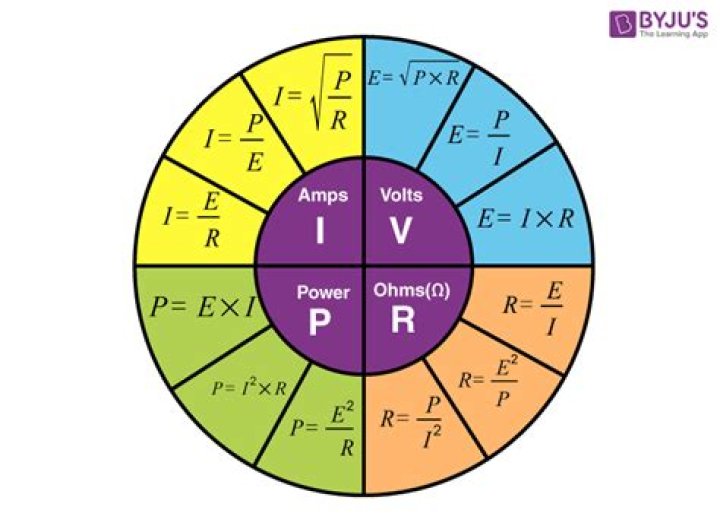
Ohm's law equation
What are some practical examples of Ohm's law?
- Ordinary household fans. You control the speed of the fans in the house by moving the button back and forth.
- Electric radiators. Electric heaters are the most common winter appliances worldwide.
- Kettle and iron.
- Design of electrical appliances.
- Fuse design.
- Charger for laptop or notebook.
How true is ohm's law?
Ohm's law only applies if the applied temperature and other physical factors remain constant. For some components, increasing the current increases the temperature. An example of this is the filament of an incandescent lamp, where the temperature rises with increasing current. In this case, Ohm's law cannot be applied.
Which is correct statement of Ohm's law?
The correct answer is choice D. Ohm's law states that the current flowing through a conductor is directly proportional to the voltage across the conductor.
How to explain ohm's law?
- Ohm's law. I stands for the electric current in amperes.
- History of Ohm's Law. The German physicist and mathematician Georg Simon Ohm (March 16, 1789 – July 6, 1854) investigated electricity in 1826 and 1827 and published the results.
- Other forms of Ohm's law.
What is the importance of Ohm's law?
Ohm's law. One of the most important and fundamental laws of electrical circuits is Ohm's law, which states that the current flowing through a conductor is proportional to the voltage across a resistor. The equation.
What is state ohm law?
Definition of Ohm's Law. Ohm's law states that the current flowing in a circuit is directly proportional to the applied potential difference and inversely proportional to the resistance in the circuit. In other words, doubling the voltage in the circuit doubles the current.
 What is Ohms Law in math?
Ohm's law is the mathematical relationship between electric current, resistance and voltage. The principle is named after the German scientist Georg Simon Ohm.
 What are some practical examples of ohm' s law definition
The three forms of Ohm's law can be used to define practical units of measurement for current, voltage, and resistance: 1 amp = 1 volt / 1 ohm 1 volt = 1 amp × 1 ohm 1 ohm = 1 volt / 1 amp 34: Practical units.
When did George George write the Ohm law?
Ohm's law was confirmed experimentally. George did several experiments with a 1k resistor and finally published an article in 1827. Fundamentals of Ohm's Law: Voltage, Current, and Resistance. Ohm's law combines three basic electrical properties: voltage, current, and resistance.
 Is the lightbulb filament a violation of Ohm's law?
A light bulb glows contrary to Ohm's law. Explanation of Ohm's Law: Ohm's law states that the voltage across a conductor is directly proportional to the current flowing through it as long as all physical conditions and temperature remain constant.
 When to use ohm's law to find the resistor?
Use Ohm's law V = R I to find the resistance R in this circuit. Now you are going to use Ohm's law V = R I and the value of R to find the current to voltage. The diagram below shows the voltage V across a resistor versus the current I flowing through the same resistor. What is the resistance of the resistor in the circuit?
How to calculate the last variable in Ohms Law?
If you have two variables, you can evaluate the latter. Cover the letter you are looking for with your hand. If the rest of the letters are on top of each other, it means that the top one is divided by the bottom one. When they are close, they multiply.
 How to use ohm's law in a triangle?
Triangle of Ohm's law. You can use this triangle to remind you of Ohm's law. How to use: Cover the letter you want to find by hand. If the rest of the letters are on top of each other, it means that the top one is divided by the bottom one. If they are close, it means they are multiplying each other.
Who is George Simon Ohm and what is his law?
Ohm's law. In 1828, the German physicist George Simon Ohm made the connection between electric current and potential difference. This connection is known as Ohm's law. Some formulas in physics are so common that they become popular knowledge that you can memorize without even trying.
 How does ohm's law work in a fan?
Here, the current through the fan is controlled by adjusting the resistance with a regulator. The component knob can be turned to obtain a variable resistance on the output terminals. For each specific input value, you can calculate the resistance, current and thus the flowing power according to Ohm's law.
 What are some practical examples of ohm' s law in the philippines
Application of Ohm's law The main applications of Ohm's law are: Determination of voltage, resistance or current in a circuit. Ohm's law is used to maintain the desired voltage drop across electronic components.
How is resistance and current measured in Ohms Law?
Ohm's law formula. The resistance R y is measured in ohms. Ohm's law formula (potential difference formula) is used to calculate resistance, current, and voltage in a particular circuit using one of two values.
 How is ohm's law related to water pipe analogy?
Ohm's law describes the current through a resistor when different electrical potentials (voltages) are applied to each end of the resistor. Because they can't see electrons, the ■■■■■■ analogy helps them better understand electrical circuits.
 How is ohm's law used in everyday life?
Ohm's law is the relationship between current, voltage and resistance and is derived from the German physicist George Simon Ohm. Applications of Ohm's law range from household appliances such as heaters to power lines and large-scale projects such as rockets and spacecraft.
Why is ohm's law not applicable to non linear elements?
Ohm's law does not apply to unidirectional electrical elements such as diodes and transistors, as they only allow current to flow in one direction. In the case of nonlinear electrical elements with parameters such as capacitance, resistance, etc., the voltage and current are not constant over time, which makes it difficult to apply Ohm's law.
Which is the correct formula for OHM's law?
Ohm's law states that the voltage or potential difference between two points is directly proportional to the current or current flowing through the resistor and directly proportional to the resistance of the circuit. Ohm's law formula V = IR.
 How will you explain ohm's law?
Ohm's law refers to one of the most fundamental relationships in electronic circuits: for a given resistance, the current is directly proportional to the voltage. In other words, if you increase the voltage in a fixed resistance circuit, the current increases. As the voltage decreases, the current decreases.
 What is the original ohm's law?
The original formulation of Ohm's law is essentially an idealized model that does not account for individual physical changes in cables or the electric field passing through them.
What is the relationship between ohm's law and resistance?
I = V R I = V R. This relationship is also known as Ohm's law. Ohm's law in this form determines the resistance of certain materials. Ohm's law (like Hooke's law) is not universal. Many substances to which Ohm's law applies are called Ohm's substances.
 How is ohm's law related to Maxwell's equations?
Ohm's law is an empirical law, a generalization of many experiments that have shown that the current for most materials is approximately proportional to the electric field. This is less fundamental than Maxwell's equations and is not always true.
 How true is ohm' s law of force
In particular, Ohm's law that R is independent of V and I (but it can still depend on other state parameters such as temperature and voltage) states that V and I are proportional. So Ohm's law is not always true.
Which is the formula for the Ohm's law triangle?
Magic triangle of Ohm's law. As already mentioned, Ohm's law is determined by the equation V = IR. The triangle of Ohm's law is useful for remembering Ohm's law when solving problems. Here the three quantities V, I and R are superimposed in a triangle with voltage at the top and current and resistance at the bottom.
How true is ohm' s law of gravity
Ohm's Law: The current flowing through a resistor is directly proportional to the voltage at its ends. Ohm's law is defined mathematically by the expression V = IR. O. V = voltage, I = current, R = resistance. Ohm's law is widely used in electrical engineering to solve circuits.
When was the law of Universal Gravitation written?
Newton's law of universal gravitation. It is a general law of physics derived from empirical observation through what Isaac Newton called inductive thinking. It is part of classical mechanics and was formulated in Newton Philosophiæ Naturalis Principia Mathematica (Principles), first published on July 5, 1686.
 Which is correct statement of ohm' s law of electricity
Defining Ohm's Law Most of the basic components of electricity are voltage, current, and resistance. Ohm's law shows a simple relationship between these three quantities. Ohm's law states that the current flowing through a conductor between two points is directly proportional to the voltage between the two points.
How is the SI unit of resistance related to the Ohm law?
Ohm's law shows a simple relationship between these three quantities. Ohm's law states that the current flowing through a conductor between two points is directly proportional to the voltage between the two points. The SI unit of resistance is ohms. This law is one of the most fundamental laws of electricity.
 Who was the first person to write ohm's law?
This law was first formulated by a German physicist named Georg Simon Ohm and was the main theory describing the quantitative properties of the physics of electricity. Ohm's law can also be seen as an empirical law.
What do you call material that does not obey ohm's law?
Any material, part, or device that follows Ohm's law, where the current flowing through the device is proportional to the voltage applied, is called an ohmic material or part. Any material or part that does not conform to Ohm's law is called a non-ohmic material or part.
How true is ohm' s law of thermodynamics
Ohm's law states that the current flowing through a conductor is directly proportional to the applied voltage, as long as the temperature does not change. As you can see, the law does not apply to temperature or to the acceptable temperature range as long as it remains constant.
How does the third law of thermodynamics work?
When a part is cleaned, its entropy decreases, but the cleaning effort has resulted in an increase in entropy outside the part exceeding the lost entropy. The third law of thermodynamics states that the entropy of a system approaches a constant value as the temperature approaches absolute zero.
 Is the constant of proportionality in ohm's law true?
In the equation, the aspect ratio, R is the resistance indicated by the Ohm unit with the symbol. The same formula for calculating current or resistance can be rewritten as follows: Ohm's law only applies if the supplied temperature and other physical factors remain constant.
 Is there any way to test ohm's law?
Therefore, there can be no verification of Ohm's law, but it is possible to verify whether an object conforms to Ohm's law or not. The current flowing through a conductor is directly proportional to the voltage on it, as long as the temperature does not change.
 How true is ohm' s law of power
Ohm's law states that current is proportional to voltage and inversely proportional to resistance. The following equation is derived from this law: With constant resistance, the voltage increases or decreases, as does the current. At constant voltage, the current decreases with increasing resistance.
Are there materials that do not obey ohm's law?
Ohm's law is an empirical relationship that accurately describes the conductivity of the vast majority of electrically conductive materials in various orders of magnitude of current. However, some materials do not follow Ohm's law, they are considered non-ohmic.
Can you use Joule's law and Ohms Law?
In resistor circuits, Joule's law can be combined with Ohm's law to create alternative expressions for power dissipation, as shown below. Below is a wheel with formulas for Ohm's law relationships between P, I, V, and R.
Is there a formula wheel for Ohms Law?
Below is a formula wheel for Ohm's Law relationships between P, I, V, and R. This is basically what the calculator does, and it's just a representation of the algebraic manipulation of the above equations.
 Which is correct statement of ohm' s law of motion
A statement that correctly represents Ohm's law: Correct answer: 1. V = IR 2. The 10 ohm resistor is powered by a 5V battery. The current flowing through the source is:.
Which is correct statement of ohm' s law of power
Formulation of Ohm's law: The current flowing through a resistor is directly proportional to the potential difference (voltage) present at its ends. Mathematical formulation of Ohm's law: V = IR. The previous two lines explain the original statement of Ohm's law. You can extend the law to establish the relationship between voltage, current, and resistance.
Who was the first scientist to verify ohm's law?
Georg Simon Ohm, a German physicist, was the first to experimentally confirm Ohm's law.
 Is the force of gravity too weak to be observed?
Gravity, or simply gravity, is the attraction between two bodies. All objects in the universe attract each other with a certain force, but in most cases the force is too small to observe due to the great distance.
What is the value of the gravitational constant?
Also the value of the gravitational constant, In SI units: × 1011 Nm 2 kg2, In CGS units: × 108 Din cm 2 g2 Vector form of Newton's law of universal gravitation. The vector form of Newton's law of gravity means that the gravitational forces acting between two particles form an action-reaction pair.
Which is true of Newton's law of gravitation?
Newton's law of universal gravitation. According to Newton's law of gravitation, "every particle in the universe attracts all other particles with a force whose magnitude is directly proportional to the product of their masses F (M 1M 2)..
What are the limitations of Ohm's law of conduction?
They are as follows: Ohm's law 1 is an empirical law that applies to maximum experiments, but not to all. 2 Some materials are non-ohmic in a weak electric field. The 3 ohm law only applies to a constant temperature conductor. Resistance changes with temperature.
Which is correct statement of ohm' s law of physics
Ohm's law formulas. There are three main types of Ohm's law formulas or equations. This is I = V / R V = IR R = V / I Here I is the resistance, V is the voltage, R is the resistance. Triangle of Ohm's law. Ohm's law is widely used in the study of electronics and electricity.
Are there any limitations to the application of Ohm's law?
Limits of Ohm's Law 1 Ohm's Law does not apply to network circuits. 2 ohms does not apply directly to inductance and capacitor circuits. The properties of diode 3 VI vary widely.
 How are materials that obey ohm's law described?
Materials and components that obey Ohm's law are called ohms, meaning that regardless of the applied value of V or I and the applied voltage or current, they produce the same resistance value (R = V/I) (DC).. with positive or negative polarity or alternating current.
Which is correct statement of ohm' s law of energy
Specifically, Ohm's law states that R is constant in this relationship regardless of the current. Ohm's law is an empirical relationship that accurately describes the conductivity of the vast majority of electrically conductive materials in various orders of magnitude of current.
How is the resistance of an ohm related to the current?
I = V R, {card style I = {frac {V} {R}},}. where I is the current through the conductor in amps, V is the measured voltage across the conductor in volts, and R is the resistance of the conductor in ohms. Specifically, Ohm's law states that R is constant in this relationship regardless of the current.
How do you calculate ohms resistance?
Calculate the resistance in ohms by dividing the voltage by the current. Ohm's law says voltage = current x resistance, so change the formula for resistance = voltage / current.
What is resistance according to Ohm's law?
Ohm's law states that the current flowing in a circuit changes when a voltage is applied, but the resistance is inversely proportional to the resistance of the conductive material. V is the potential drop (voltage) across the resistor. R is the resistance value of the resistor, expressed in ohms.
How does Ohms Law relate to resistance?
Ohm's law relates the resistance of a component to its voltage and current. Applying circuit rules for current and voltage using Ohm's law, they can formulate rules for determining impedance. All conductors have a certain resistance to electric current, which is called resistance.
What is ohm's law equation
Ohm's law is one of the basic equations used in the analysis of electrical circuits. This applies to metal cables as well as circuit components (resistors) specially designed for this behavior. Both are widely used in electrical engineering.
 What is the SI unit of Ohms Law?
Ohm's Law Georg Ohm's law connecting current, voltage and resistance in a circuit is that voltage is equal to current times resistance. Resistance (R) Resistance of a material to the passage of electrical current The SI unit is Ohms (Ohms).
 What is mathematically describes ohm's law?
Ohm's law is the mathematical relationship between electric current, resistance and voltage. The principle is named after the German scientist Georg Simon Ohm. In direct current (DC) circuits, Ohm's law is simple and linear.
 Ohm's law equation in words
Ohm's law shows the relationship between three quantities: voltage, current and resistance. Ohm's law can be written as a verbal equation: voltage = current × resistance, or by using symbols to denote the magnitudes of voltage (V), current (I), and resistance (R):.
What is the correct power formula in Ohms Law?
Using Ohm's law and substituting the values for V, I, and R, the formula for electrical energy can be found as follows: To find the power (P) P (watt) = V ( Volt) to find xi (amplifiers).
What is ohm's law formula?
Ohm's law is a formula used to calculate the relationship between voltage, current, and resistance in an electrical circuit. Ohm's law (E = IR) is just as fundamental to electronics students as Einstein's equation of relativity (E = mc²) is to physicists. E = I x R.
What is the Ohms Law formula for a magnetic circuit?
Analogy of Ohm's Law: Ohm's law for magnetic circles can be defined as follows: The magnetic flux (Φ) created in the circle is directly proportional to the magnetic driving force (=).
What is the power Ohms Law?
Ohm's law. Ohm's law defines the relationship between power (P), voltage (E), current (I) and resistance (R). One ohm is the resistance value through which one volt can withstand a current of one amp.
What is the equation for ohms?
Ohm's law can be written as a simple mathematical equation: I = V/R, where I is the electric current measured in amps, V is the voltage and R is the resistance.
<img src=‘’ alt=‘ohm’s law equation’>