Has been vs have been
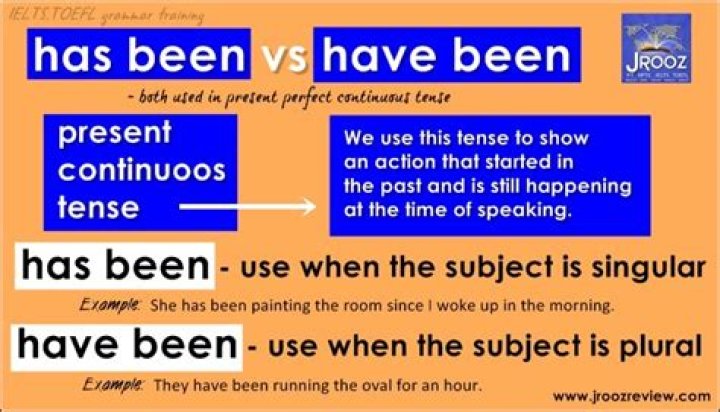
What is the difference between has been and have been? Key Difference: Has Been is most commonly used in third person while Had Been can be used in both first and second person. It can also be used in the plural for a third person. "Was" and "was" are two different words that are often confused in English.
When to use 'had been'?
"What" is used to indicate a gift that is always perfect. This form is used to refer to what began in the past and continues to this day. "What" is used to indicate the continuous past tense.
When to use has, had and have?
- speak in the first person (I, we)
- Talk to the second person (you)
- speak in the third person plural (she)
Is it have been or have being?
The verb to be does not have a perfect continuous form (verb structure). It was always wrong to say whether it was or was.
What's the difference between 'had been' and 'were'?
• Anyone who insinuates that the action has already ended because it is a simple past tense, but implies that the action happened in the past when used in the past tense. This is the difference between the two words, namely, they were and they were.
What is the difference between had, has and have?
1. "Has" is the third person present singular of the word "have", while "a" is the present and past participle of the third person of the word "have". 2. Both are transitive verbs, but 'has' is used in sentences about the present, and 'has' is used in sentences about the past.
 What is the difference between "has become" and "has became"?
As for verbs, the difference between will and will is that will (will), and will (obsolete) arrive, arrive (at the place).
What is the difference between has been and have been in spanish
A/ was at the perfect time. A / referred to a place a person has visited at some point in their life. In other words, there was talk of a travel experience. The must/must form always indicates that the person has returned or is no longer there.
When do you use have vs have in a sentence?
The short answer when comparing has vs have is that has is used in the third person singular. Have is used with the first and second person singular, plural and third person plural. If this confuses you a bit, or if you don't remember exactly how the first, second, and third person differ, don't worry.
When to use'have gone to'and'had been to'?
Both were and are gone, and can be used in the ideal ways of the future and the past. He indicated that someone is going elsewhere and coming back. On the other hand, it was indicated that the person was absent at some point in the past. Here are some examples:.
When do you use have in the present tense?
Have is used with the first and second person, present and plural of the singular, and true third person of the plural. Again, in plain English, this simply means you use have when speaking in the first and second person singular and third person plural with the pronouns yo, tú, nosotros, and ella. I have a lot for you.
Has been vs have been usage
“Was” is used in the perfect continuation present in the first, second, and third person plural while “was” in the singular is only used for the third person.
 What is the difference between has been and have been meaning
Without going into technicalities, there are two main differences: "Was" means something happened in the past and it's over. "Were" and "Were" are used to indicate that something started in the past and continues in the present.
 What's the difference between had been and had been?
"Was" basically follows similar parameters, but for a continuous ideal past rather than an ideal present. In this case, "eu" does not change depending on the subject (singular or plural); it's always "eu". “It's been in my head for a long time.
 When to use have been in the present tense?
“Were” is a verb used to form the present perfect tense, and when followed by the present participle (e.g. “run”, “walk”, “do”, etc.), the present perfect tense goes further. This means that the action is in progress and has not yet been completed.
Which is the correct meaning have or has?
Although the verb has many different meanings, the main meaning is "to possess, possess, store, use or contain". Own and indicate in the present tense (describe the events taking place in the moment).
 When to use " has " and " played " in a sentence?
You completed the job on time. She has learned an important lesson. For example, the sentence "He played banjo for four years" has an auxiliary verb (an auxiliary verb used to build verb forms), and play is a past participle. As in the previous examples, has is used with the third person singular.
 What's the meaning of "would have been"?
Had is used with the main verb. If you see "will" in a sentence, it means that the action didn't actually happen because something else didn't happen in the beginning. If I had money I would give it to you.
What is the difference between has been and have been in sentence
"Was" is used in the perfect continuation present in the first, second, and third person plural, and "was" in the singular is used only for the third person. Help them improve.
 When do you use has had and have had in a sentence?
You should have used if something was done a long time ago, not recently. But if something was done recently, you can had or have, depending on the pronoun.
 When do they use has, have and had?
- In this context, the verb a is used.
- The verb has, on the other hand, is used in the simple past tense.
- Also, the verb had is used to denote a possibility.
- It is interesting to note that both has and had are also used in the case of continuous tense, for example B. Present perfect continuous and past perfect continuous.
Can you use the word had had in a sentence?
You used had eu wonderful in the past tense when the main verb also says, "Last weekend I just wanted to relax because I had a busy week." The manager told me he had a meeting with the president. They had problems with the washing machine, so they called a locksmith. He woke up screaming because he had a nightmare.
When did the Bell P-39 Airacobra End production?
When production of the P39 ended in August 1944, Bell built 9,558 Airacobra aircraft, of which 4,773 (mostly -39N and -39Q) were shipped to the Soviet Union under the LendLease program.
 What was the Bell P-39 used for in World War 2?
The Bell P39 Airacobra was one of the most important American fighters in service as the United States entered World War II. Used by the Soviet Air Force, the P39 enabled individual Soviet pilots to inflict the highest casualty rate associated with any type of fighter aircraft used by the Air Force in conflict.
 What was the purpose of the bell XP-39?
The XP39 project was adopted, and in June 1939, General Henry H. Arnold commissioned a prototype for evaluation in NACA wind tunnels to find ways to increase speed and reduce parasitic drag.
What was the critical altitude of the Bell P-39?
The production P39 was equipped with a single-stage rate-of-rise compressor with a critical altitude (above which power decreased) of approximately 12,000 feet (3,660 m). This simplified the manufacture and maintenance of the aircraft. However, removing the turbo ruined any chance the P39 could serve as a top fighter at high altitudes.
 When to use ' had been' in order
39 Clues Book Publishing Order Labyrinth of Bones (2008) Into the Gauntlet (2010) Series 39 Clues #1 (2010) Vesper Rising (2011) Black Book of ■■■■■■ Secrets (Compan.
 Is there going to be a 39 Clues movie?
A 39 Clues fan has a lot to read. To further document the great success of this series of novels, a film is being made based on this series.
Who is older Dan or Amy in 39 Clues?
Amy is the older of two siblings and is portrayed as very knowledgeable. When they were younger, their parents died in a fire, leaving the young couple orphans. Amy was only 7 years old when her mother and father died, and Dan was only 4 years old.
How do you use had in a sentence?
The verb have is used in the present perfect form. Look at the current proposal: I have a lot of homework. That means I have a lot of homework now. On the other hand, they use the present to describe a past event related to the present.
 Is “have” singular or plural?
1. "A" is a singular verb. "Have" is the plural. 2. "Have" is used more often because it can still be used properly in the singular. "A", on the other hand, is only used in the third person singular.
Is 'has' a verb?
What is the verb used for? You can use the verb "a" to show yourself or own something. It can also be used for sentences in present and present. Sometimes you also have to use the verb a for the third person singular.
How to use had no in a sentence?
- Also select a word if you can also replace a word.
- For example: She was also (too) bad or I (too) can see you.
- It can also be used to change or highlight a word.
- For example: it is too (too) hot, I have eaten too much (too much) or the packaging is too (too) large.
- He was not (very) interested in my book.
Which is correct, had been or have been?
They are used in the perfect continuation present in the plural in the first, second and third person, and in the singular it is only used for the third person.
 When to use "has/have/had been" and "having been"?
Both Rabbits and Been are written in the present tense. It is used in the third person singular and in the first and second person singular and all uses of the plural. The ideal gift is associated with an action that started sometime in the past and continues.
Is it have been or have being meaning
One can easily distinguish summer from his by understanding its meaning and usage. Since summer is an earlier form of "being", it is used to refer to something that is not happening or is happening but happened some time ago while being reflects what is happening.
What's the difference between being and been in English?
Finally, let's see how they are pronounced. Pronounced in two syllables, ser while there is only one syllable and sounds like "garbage", like "canasta". To learn more about these and other topics, consider taking English classes at LCI Language Centers.
When to use'have been','has been'and'had been'?
They use "was" when describing something that happened in the past rather than something else in the past. Also an act that has taken place in the past and is not a continuation in the present. Example: around 500 AD. The Roman Empire was defeated. It was, it was, it was a questionnaire.
When to use " being " after the word " been "?
It used to be after his (, am, is, his, was, were). For example: the biggest advantage is Paris. He was an idiot. Use after the verb have (, a, a, had, have). For example: I went to Paris. The cougar was seen in the city. Understood? Do a quick test.
 Is the word " been " a participle or a verb?
The words summer and orphans are sacraments. Let's go to the glitches for a moment. Leg is a past participle. Summer is the past participle of the verb sein.
 Is it have been or have being in love
Falling in love is a part of life that many people aspire to (and it may seem that all the characters in movies, books, and other stories they love focus on them in one way or another. There are many different kinds of love.
Do you love someone instead of being in love with them?
You may be thinking 'I love her' instead of 'I love her'. This transformation doesn't necessarily mean there is something wrong with your relationship. Loving someone instead of feeling "in love" just shows how romantic feelings develop in relationships, especially in long-term ones.
 How can you tell if someone is in love with you?
If your partner has ever noticed that you look lovingly at him, it could be a sign that you are madly in love. Eye contact means you're obsessed with something. So if you find that your eyes are on your partner, you can fall in love.
 Is it normal not to feel good when you are in love?
It's okay not to feel so good. When you are nauseous and sweating, your stomach hurts or you fall in love. One study found that falling in love can cause nausea and physical symptoms such as anxiety or stress, such as sweating.
What is the meaning of " it would have been better if "?
1 It would be better if the government banned the production of fireworks. The proposal is for the future. His second sentence refers to the past and expresses his regret. - Nov 11, 6:51 PM.
What's the difference between " I've Never Been Better "?
I've been better and I've never been better - here are two general answers to the question, how are you? where you do it, but they mean very different things. I used to say you're not doing well or you're having a bad day/week/month/year.
What's the difference between " being " and " been "?
What is the difference between being and being? It used to be after the verb be (, am, is, are, was, were). For example: the biggest advantage is Paris. He was an idiot. Use after the verb have (, a, a, had, have). For example: I was in Paris.
 When to use " should have been " instead of " could have "?
It is stronger than it "could". Use "should" to indicate what you think should have happened, but didn't. You often hear this phrase in quarrels or laments about the past. "You shouldn't have lied to me!".
 Is it have been or have being in spanish
Writers sometimes confuse the words "to be" and "to be". As a rule, the word "summer" is always used after "have" (in any form, "a", "age", "aura", "aura"). The word 'to be' is never used after 'to have'. Ser is used after his (somehow am, is, his, was, were).
 Is the word " been " a past participle of the verb " have "?
Leg is a past participle. The word summer is the past participle of the verb to be. Therefore, it can be used with have (in all its forms) to create perfect (or complete) bits.
When to use'been'and'has'in a sentence?
Been is always used together with the verb have, which is the auxiliary verb. The auxiliary verb to be, on the other hand, is the verb to be (, is, to be, was). For example: it's stupid. He was stupid. (Remember, this is part of it). It was stupid.
 When do you use the word being after the word have?
In general, the word "summer" is always used after "have" (in one of its forms: "a", "era", "aura", "aura"). And conversely, the word "to be" is never used after "to have". Genesis used after ser (in any of its forms: am, is, are, was, were) Examples:.
 What's the difference between have been and have been past participle?
The perfect passive of the present is not the past participle + have been. In fact, this is Have Been V+ing, also called Present Perfect Progressive or Present Perfect Continuous. It is used for activities that started in the past and continue to this day.
When do you use the word being with the word be?
The word sein is the past participle of the present verb sein. Therefore, it can be used with be (in all its forms) to create bits in a progressive (or continuous) look.
 What's the difference between have been and have been V-ing?
The perfect passive of the present is not the past participle + have been. In fact, this is V+ing, also known as Present Perfect Progressive or Present Perfect Continuous. It is used for activities that started in the past and continue to this day.
Has been vs have been grammar
"Were" should be used when using the first and second person singular (I, you, we, they) or when a plural name means the same as "was". It should have been used when something happened and ended in the past and not happening again.
Has been vs have been vs had been
"Was" means that something happened in the past and it is over. "Were" and "Were" are used to indicate that something started in the past and continues in the present. 1. “Was”: Something started in the past, lasted for a while, then ended.