Divergent Boundary Examples - How To Discuss
Divergent Boundary Examples
What is an example of a divergent continental boundary?
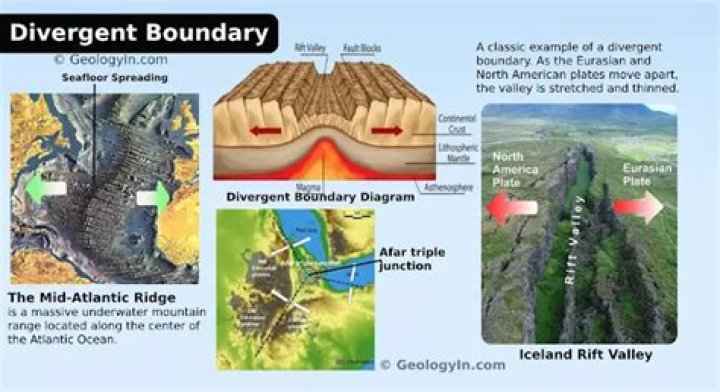
A diverging edge is marked by two plates spaced apart from each other. Iceland is an example of a country crossing an aberrant continental border. The Mid-Atlantic Ridge divides Iceland and forms the boundary between the North American and Eurasian tectonic plates.
So we can also ask ourselves: what is an example of a deviant limit?
Examples of Diverging Boundaries The Mid-Atlantic Ridge is an example of a diverging boundary where the Eurasian Plate, which covers all of Europe, differs from the North American Plate. These seamounts are constantly growing as new crusts form.
What forms the boundaries of the diverging plates besides the above?
When two plates move away from each other, we call this diverging plate boundary. Along these borders, magma rises deep into the earth and erupts to form a new crust on the lithosphere. Most of the diverging plate boundaries are submerged and form underwater mountain ranges known as ocean ridges.
So where is a different limit?
Diverging boundaries are marked in the oceanic lithosphere by fissures in the oceanic ridge system, including the mid-Atlantic ridge and eastern Pacific ridge, and in the rift valley continental lithosphere such as the famous Grand Valley East African Rift.
What are some examples of processing limits?
San Andreas connects a divergent boundary in the Gulf of California with the Cascadia subduction zone. Another example of a transformation boundary on land is the New Zealand Alpine Fault. The San Andreas Fault and the Alpine Fault are displayed on our interactive plate tectonics map.
Are there earthquakes that cross borders?
Yes, a deviating plate boundary can cause earthquakes. There are two main types of diverging boundaries that extend ridges in terrestrial oceans and canyons. They cause earthquakes in different ways. The boundaries of diverging plates on earth (fissure valleys) occur in a much thicker crust, so they work very differently.
What are the 3 things that form on a deviant border?
Impacts found on a divergent boundary between oceanic plates include: an underwater mountain range like volcanic activity in the Mid-Atlantic Ridge in the form of eruptions, shallow seismic activity creating a new seabed, and expansive basins.
What are the two characteristics that are usually found on divergent boundaries?
different plaque limits?
(1) mid-ocean ridges and valleys. (2) wide valleys and deltas. (3) ocean depressions and subduction zones.
What happens under different limits?
A divergent boundary is a place where convection currents rise up the mantle. This magma growth divides and spreads the earth’s crust. Diverging borders occur between the sea ridges. A new crust forms in the middle of the sea ridges, which is divided into two different tectonic plates.
Is the Grand Canyon a different frontier?
There are diverging plate boundaries where two plates separate and move away from each other (Fig. The hot melt material rises to the surface along the plate boundary and forms a new marine crust. One day a new boundary of diverging plate could form west of the Grand Canyon in Basin and Range province (Fig.1.1)
What is the shooting ring and where is it?
The Pacific Ocean
What causes the transformation boundary Valley formation linear thin and divided river beds A well known example of a transformation boundary is the San Andreas Fault in California What does a deviant boundary mean?
The Red Sea and mid-ocean ridge (which stretches across the Atlantic) are divergent plates associated with Aries What is the opposite of subduction?
There are no categorical opposites for the subduction zone The self-subduction zone The name is defined as: An area of the earth in which a tectonic plate immersed in the earth under an alt ro.
What are the 3 causes of disc movement?
Mantle convection currents, crest and plate pull are three of the forces proposed as the main driving forces of plate movement (based on What Drives the Plates?
Pete Loader). There are a number of competing theories that attempt to explain what drives the movement of tectonic plates.
Why are tectonic plates moving?
The plates on the surface of the planets move due to the intense heat in the Earth’s core, which causes molten rock in the mantle layer to move. It moves in a pattern called a convection cell and is formed as hot material rises, cools, and eventually sinks. As the cooled material flows, it heats up and rises.
What is the theory of plate tectonics?
Plate tectonics is the theory that the Earth’s rigid outer layer (the lithosphere) is divided into a few dozen plates that move relative to each other on the Earth’s surface, like ice shelves on a lake.
What is the difference between the boundaries of converging and diverging plates?
Diverging boundaries are the boundaries where the plates separate, creating earthquakes and mild volcanoes as the magma reaches the surface. Converging boundaries are the boundaries where two plates slide into each other.
How many tectonic plates are there?
sv