Define phoneme - How To Discuss
Define phoneme
What is the difference between morpheme and phonemes? What is the difference between morpheme and phoneme? Morphemes are the smallest important elements of a language. Phonemes are the basic units of speech in a language that are used to make morphemes and words. The main difference between morpheme and phoneme is that while the morpheme has a specific meaning, the phoneme itself does not matter.
What is the difference between a phoneme and a syllable?
The main difference between a phoneme and a syllable is that the phoneme is the basic unit of phonology and the syllable is the organizational unit of the set of vowels. Wikipedia. For the unity of gestures in sign languages, see Chereme. A phoneme is one of the units of sound that distinguish one word in a particular language from another.
What is the difference between phone and phoneme?
Summary A phoneme is a mental representation of a sound, not necessarily a letter. A telephone is a phonetic representation of a phoneme (real sound). Allophones are different ways of pronouncing the same phoneme while retaining the same meaning. Sometimes allophones are predictable, depending on your environment and speaker.
What does phonemes mean?
Definition of phoneme: any abstract unit of the phonetic system of a language that corresponds to a set of similar sounds (z in the language.
Can morpheme be represented by single phoneme?
The short answer is yes, there are many morphemes that consist of the same phoneme. A phoneme is defined as an indivisible unit of sound known to participate in communication within a language. A morpheme is defined as any sound unit that corresponds to an indivisible meaning.
What does morpheme mean?
Morpheme Definition. - A characteristic arrangement of phonemes (for example, free-form spindles or connected spindle shapes) with no significantly smaller parts.
How are morphemes and sentences similar?
It is the smallest grammatical unit in the language. A sentence is an autonomous set of words. Morphemes and sentences are similar in that they are both units of meaning, although they do so on different levels.
What is morpheme examples?
A morpheme is the smallest linguistic part of a word that can have a meaning. In other words, it is the least significant part of the word. Examples of morphemes can be the one, brittle and capable parts in the indestructible word. There are 5 types of morphemes: This short article can be extended.
 What is the difference between morpheme and phonemes in spanish
The main difference between the morpheme and phoneme is that the morpheme is the smallest significant unit in the language, and the phoneme is the smallest unit of contrast in the phonetic system of the language… Also, morphemes refer to the meaning and structure of the language, and the phoneme refers to the sound and pronunciation of the language.
What's the difference between a phoneme and a letter?
Basically, it's sound versus symbol. A phoneme is a sound that distinguishes words from each other. Phonemes are the basic units of a language that make up morphemes, words, and sentences. A letter is the symbol of a sound in a language.
Can a morpheme be split into different parts?
The morpheme cannot be broken into pieces. Phonemes can be divided into several parts. The term morpheme comes from the French word and means "shape, shape". This is an analogy with the word "phoneme", which comes from the Greek word.
 How many phonemes in a word?
There are 42 phonemes in English. Counting phonemes in words is one of the easiest ways to pronounce a word correctly. However, it can be a bit confusing if the number of phonemes does not match the number of letters in the word. Here are some ways to count phonemes in a word.
 What is an example of a phoneme in English?
A phoneme is a sound or group of different sounds perceived by native speakers of a language or dialect as having the same function. An example is the English phoneme /k/, which occurs in words like cat, kit, scat, sketch.
 What is the difference between a phoneme and a syllable diagram
A phoneme is a unit of sound used by the language community. Phonemes include all the different units of sound used by native speakers. This includes vowels and consonants. A syllable is a group of sounds that contains at least one vowel.
Which is the correct definition of a syllable?
(linguistics) Unit of human language that the listener interprets as a single sound, although syllables usually consist of one or more vowels, singly or in combination with the sound of one or more consonants, a word consists of one or more consonants. more syllables. A written representation of a specific spoken syllable.
What does a phoneme mean in a sentence?
A small part of a sentence or speech, something laconic or short. In phonology and linguistics, a phoneme is a unit of sound that distinguishes a word of one language from another.
 Which is an indivisible unit of sound in a language?
The unity of an indivisible sound in a particular language. A phoneme is an abstraction of the physical sounds of a language (telephones) and can contain several phonemes.
What are the types of phoneme?
The phonemes in the CMU pronunciation dictionary are divided into eight types: Fricative. To resist. vote. Average vowel. Stop. To strive.
Is the sound of the phoneme p the same?
Although the sound that occurs in all these words is not the same, the sound of the phoneme p is perceived to be the same and it is believed to use the same phoneme /p/. What is an allophone? Different sounds can be made for the same phoneme.
 What is the purpose of syllable and Phoneme Segmentation?
Syllable and phoneme segmentation refers to the ability to identify the component parts of a word, phrase, or phrase. Determining the number of syllables in a word or sentence (again using auditory, visual and/or digital representations) is a very important step in the development of phonological awareness.
 What are the 44 phonemes in English?
44 phonemes in English. Although there are only 26 letters in the English language, there are about 44 unique sounds, known as phonemes. 44 sounds help distinguish one word or meaning from another. Different letters and letter combinations are used to denote sounds, known as graphemes.
What is the difference between sound and phoneme?
A phoneme is a unit of sound in a language that cannot be further broken down. This is the most basic unit of sound. If the sound produced by the letter T in English is the most basic unit of sound, it is called a phoneme. A phoneme is a pronunciation or sound that cannot be changed if the meaning remains the same.
What is the relationship between morpheme and phoneme?
The morpheme is the meaningful building block of language and the phoneme is the building block of sound in language. A morpheme cannot be divided into parts, but phonemes can be divided into parts. The term morpheme comes from French, the inverse phoneme comes from the Greek word.
What are the main differences between phonetics and phonology?
The main difference between phonetics and phonology is that phonology is the study of the sounds of a language and phonology is the study of sounds, especially the different sound patterns in different languages.
What is the plural of allophone?
The plural form of the allophone is the allophone.
What is the plural of phoneme?
Phoneme (plural of phonemes) An indivisible unit of sound in a particular language. A phoneme is an abstraction of the physical sounds of a language (telephones) and can contain several phonemes.
What's the difference between a phone and an allophone?
Although a telephone is a sound representation of a phoneme or the sound of a word, it is called a phonetic representation. The latter term, allophone, refers to different ways of representing a phoneme or different ways of pronouncing a word.
 What's the difference between a phone and a phoneme?
Therefore, the difference between these terms lies in the phoneme, which is a mental representation of the sound of a word. Although a telephone is a sound representation of a phoneme or the sound of a word, it is called a phonetic representation.
 Which is an allophone of the phoneme Todd?
This means that in American English you can say that is an allophone of the phoneme /t/. But sometimes the phoneme /t/ uses the sound , as in the name Todd: From these examples you can see that the phoneme /t/ has at least two allophones: and .
Which is the phonetic representation of a phoneme?
A telephone is a phonetic representation of a phoneme (real sound). Allophones are different ways of pronouncing the same phoneme while retaining the same meaning. Sometimes allophones are predictable, depending on your environment and speaker.
What language uses the most phonemes?
Taa /ˈtɑː/, also known as ǃXóõ (ǃKhong, ǃXoon - pronounced , English: /ˈkoʊ/), is a Tuu language with a large number of phonemes, possibly the largest in the world. Most of the speakers live in Botswana, but a few hundred in Namibia. People call themselves Xoon (pl. ǃXooŋake) or ʼNohan (pl.
How many types phonemes in the word?
Phonemes are the basic voice gestures of a language that are used in all spoken words. There are about 42 different phonemes in English. These 42 mouth movements are the interchangeable parts that make up all your words.
 What are examples of phonetics?
- Phoneme The smallest unit of sound in your spoken language.
- Grapheme A written letter or group of letters that indicates the sound of speech.
- Principle The initial consonant sound or group of consonants.
- Rhyme A vowel or vowel, as well as the consonants following the beginning.
- Bigram Two letters that indicate the sound of speech.
Do phonemes have meaning in spanish
Spanish is perhaps the most phonetic of all. It is called an easy language and students in France or Germany tend to learn Spanish as a second foreign language because most of the words sound like they are written. international phonetic alphabet.
Does Spanish have more words than English?
Also note that Spanish is syllables spoken per second and English is syllables spoken per second. It follows that Spanish is about 25% faster than English. Consequently, the Spanish language corresponding to a 300-word English document is about 50 to 100 words longer.
 Is Spanish a more expressive language than English?
There are many nonsensical rules in Spanish grammar. Many Hispanics simply do not understand the complexity because it is their first language. The grammar of the English language is very simple. Spanish is usually a much more expressive language than English.
 How do you say vowel in Spanish?
The good news is that vowels in Spanish are only pronounced in one direction. If you want your Spanish to sound like a native speaker, you need to focus on your vowels. Them. a (ah): attack (ahtahkahr) (attack) e (eh): understand (ehntehn - dehr) (understand) i (ee): live (bveebveer) (live).
 Do phonemes have meaning worksheet
A phoneme is part of a word. A phoneme is a unit of language that is not relevant in itself. But when you put phonemes together, words are created. A phoneme is a unit of a language and each phoneme has an intrinsic meaning, such as Latin or Greek roots.
How many phonemes are there in the English language?
There are 44 phonemes in English, each of which is a separate sound that, when combined, helps to distinguish the words from each other (cat /k /a /t/). These free worksheets focus on the relationship between sounds and letters and allow students to practice spelling words with spoken language.
 How do phonemes help them understand the history of their language?
Phonemes help them understand the meaning of words because they are the basic unit of the words they speak, write and read. Phonemes help them understand the history of your language, as word meanings often change over time. None of the answers given.
What can you do with a phoneme mapping worksheet?
Use the listening and phoneme assignment worksheets to practice short vowels, mixtures, digraphs, long vowels, CVCe-checked words, R-words, and diphthongs. You get 42 auto-response prints that are perfect for student self-study, the literature center, homework assignments, or as a substitute for a meaningful lesson.
 Do phonemes have meaning chart
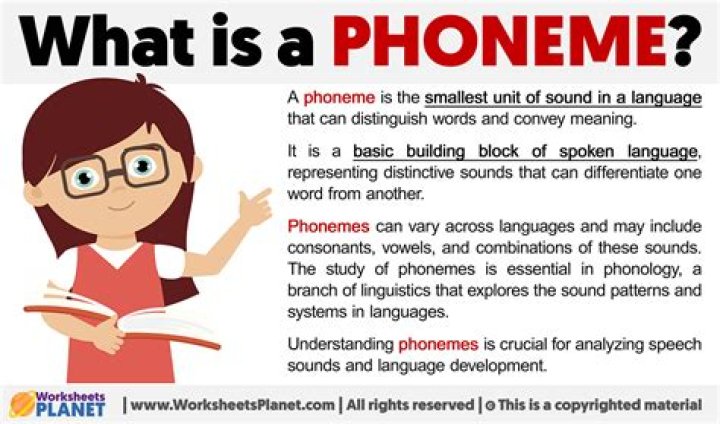
They explain how the teacher explains phonemes and how you can help your child when he starts composing sounds at home. What is a phoneme? A phoneme is the smallest unit of sound that distinguishes a word from another word in a language. This image shows all the phonemes used when speaking in English.
What's the difference between a grapheme and a phoneme?
The phoneme sounds phonetically, it is a method of teaching people to relate sounds to letters. A grapheme contains an image of words. * Graphemes are symbols, just as graphs are visual representations of information.
 How are phonemes used to make short words?
This image shows all the phonemes used when speaking in English. At the reception, children learn the individual sounds of the individual letters of the alphabet. Then you start putting these sounds together to make short words like cat, stack, pin, knock, etc. This is called tone mixing.
What are the phonemes in the word school?
And for something more complicated, the word "school" has four phonemes: the sound "s", the sound "k", the long sound "yu" and the sound "l".
 How are Hindi and Urdu phonemes related in Hindustani?
These are separate phonemes in English, but they are both allophones of the /ʋ/ phoneme in Hindi (written as ⟨व⟩ in Hindi or و⟩ in Urdu), including Arabic and Persian loanwords. To be precise, these are conditional allophones. The rules apply to find out whether ⟨व⟩ is pronounced or , depending on the context.
How is the phonology of Hindi compared to English?
This is in stark contrast to English, which is why Hindi students may find it difficult to write in English. On the contrary, they may mispronounce the words they first find in writing. Phonology: Hindi has about half the number of vowels and twice as many consonants as English.
 Which is more common in English or Hindi?
Clusters of consonants at the beginning or end of words are more common in English than in Hindi. This leads to errors in the pronunciation of words like Straight (Istraight), Fly (Faly), Film (Filam). Compared to English, Hindi has a weak but predictable verbal accent.
 Why are Hindi words so difficult to learn?
Hindi is very phonetic, the pronunciation of new words can be reliably predicted from your writing. This is in stark contrast to English, so Hindi learners may have difficulty spelling in English. On the contrary, they may mispronounce the words they first encounter while writing.
 What is segmental phoneme?
Segmental phoneme. Last name. : one of the phonemes (e.g. \\ k, a, t \\ in cat, tack, act) of the language, which can be referenced by the relative order of minimum segments to the supersegmental phoneme.
What is the difference between a phoneme and a morpheme?
Phonemes are combined into morphemes and words. The main difference between the morpheme and the phoneme is that while the morpheme matters, the phoneme itself does not matter. It's just a unit of language. For example, if you take the word "walk" it is a morpheme, meaning it conveys meaning.
What does the name phonics mean?
What does the word "phonetic" mean? Phonetics is a method of learning to read and write English by developing students' phonemic awareness, the ability to listen, identify and manipulate phonemes to learn the correspondence between these sounds and the spelling patterns they represent.
 What does phonics mean definition?
Definition of Phonetics 1: The Science of Sound: Acoustics 2: A method for teaching beginners to read and pronounce words by learning the phonetic meaning of letters, letter groups and especially syllables 1: Science of Sound: Acoustics.
What is the difference between grammar and phonics?
Grammar is a fairly vague term, although phonology (the study of the sound systems of languages) seems to fall within its scope. The part of grammar most clearly related to phonetics is morphology, which deals with the grammatical structure of words.
How are graphemes used to identify a phoneme?
graphemes. A grapheme is a symbol used to refer to a phoneme; is a letter or group of letters that represent a sound. They use letter names to refer to graphemes, such as the letter "c" in cars, where the letter "c" is represented by the letter "c". The two-letter grapheme is in "team", where "ea" denotes the long "ee".
What is the difference between a grapheme and a phonogram?
If you speak pure English, you will often see a different definition of grapheme. In this case, a grapheme is a letter or group of letters that represents a phoneme. This is a term used more or less synonymously with phonograms. Often there are many graphemes (or phonograms) that can represent a phoneme.
 What's the difference between a digraph and a phoneme?
The phoneme sounds phonetically, it is a method of teaching people to relate sounds to letters. A grapheme contains an image of words. * Graphemes are symbols, just as images are visual representations of information. The digraphs are two letter graphemes. Remember this trick, because the digraph has the prefix di, which means two.
 What is the meaning of a grapheme in the alphabet?
Graphemes may or may not have meaning. A grapheme refers to a letter of the alphabet, but sometimes two or three letters of the alphabet can be seen as a grapheme, they are called a digraph and trigraph respectively.
 Why is phonological awareness so important?
Phonological awareness is an important and reliable indicator of reading skills. You need to learn and use the alphabetic code. People who can pronounce words, recognize these sounds and reconstruct them know the alphabetic code well.
 What does phonemic awareness stand for?
Phonemic awareness (PA) is the ability to hear and control sounds in spoken words and to understand that spoken words and syllables are made up of sequences of speech sounds (Yopp, 1992, see References). Indispensable for learning to read in the alphabetic script, as the letters represent sounds or phonemes.
How do I teach phonological awareness?
When it comes to teaching phonological skills, fun games, songs, and hands-on activities have proven to be very effective methods. You can encourage talking as part of your daily routine. Nursery rhymes, songs, poems and reading are effective ways to develop your phonemic skills.
How do I improve phonological awareness?
8 ways to develop, question and defend phonological awareness in primary school students. Phonological awareness is not taught in all classes. Make it a routine. Once you know what specific skills your child needs to work on, you can practice them in your daily activities. Click on your child's feelings. Use objects that your child can see and touch to indicate the sounds of words. Movement. Customize your board games. go online.
What is the importance of blending?
Blending makeup is one of the most important aspects of applying makeup. The blend provides the best coverage and at the same time ensures that your makeup looks perfect and professional. Blending also gives you a variety of options such as mixing different colors to apply eyeshadow as well as concealer and concealer applications.
What is the adjective for blending?
This reference page can help answer the question of which adjectives are commonly used to describe MIX. beautiful, complete, civilized, curious. soft, refined, progressive, cheerful. harmonious, intimate, reasonable, special. perfect, weird, great, the same. unique, cute, strange, delicate.
What is segmenting and blending?
2-minute version - Shuffling and segmenting are important audio skills. Segmentation is the process of dividing a word into individual words. Think /c//a //t/. Mixing is the process of putting the sounds of words together, reading or listening to a word. The students do this first ■■■■■■, in plain language, then read and spell the words.
 Define phonemic
Phoneme. (fəˈni mɪk, foʊ) adj. 1. of or related to phonemes: phonemic system. 2. phonemes or related. 3. To relate to the distinctive vocal elements of the language or to their distinctions: phonemic contrast.
What does phonemics mean?
Phonemic: study of the phonetic system of a particular language, analysis and classification of its phonemes.
What is another word for phonemic?
phoneme | Definition: (linguistic) one of a small set of speech sounds distinguished by speakers of a particular language | Synonyms: conditional child, telephone, allophone, child | Antonyms: consonant, vowel, inappropriate, broken, inappropriate.
 Define phoneme identity
Phoneme identification: Children recognize sounds when given a list of words. Which sounds do these words combine (for example, a list of words with the same beginning or ending sound)? Phoneme categorization: Students learn to identify a different sound in a group of words.
 What is a common phoneme?
A phoneme is a sound or group of different sounds that native speakers of a particular language or dialect perceive with the same function. An example is the English phoneme /k/ found in words like kat, kit, scat, skit.
 What is Phoneme Segmentation Fluency?
Phoneme Segmentation Fluency (PSF) is a concise and direct measure of phonemic awareness. PSF measures the ease with which a student breaks a spoken word into its component parts or sound segments. Using standard instructions, the assessor pronounces a word and asks the student to pronounce the sounds in that word.
 What does grapheme mean?
Grapheme Definition. 1: A unit (such as a letter or digraph) of writing. 2: a series of units in a script (for example, letters and their combinations) that make up a phoneme.
How many graphemes in English?
Graphemes are letters or combinations of letters that usually distinguish words from each other, correspond to sounds/phonemes. English has 26 letters and 44 phonemes. There are about 250 graphemes in English.